Kitty Pride and Professor (really) X (Spoilers!)

skeevy

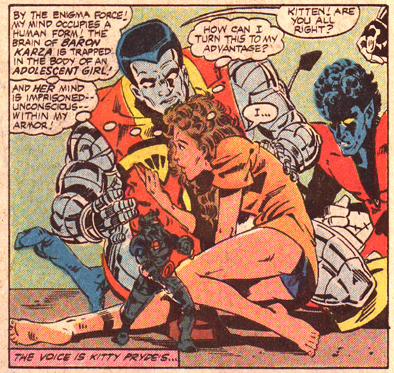
So, do you remember the time Professor X tried to do it with the teen-age Kitty Pride, but it wasn’t Kitty Pride but actually Baron Karza, the supreme enemy of the Micronauts?

The subplot, featured in the 4 issue x-Men and the Micronauts mini-series, flirted with Sub/Dom TG.    Baron Karza, trapped in the body of a female and dressed like a slave girl, on his back in such a vulnerable position, his arch-enemy, dominant, ready to make his move.  In the book, realizing his enemy intends to have sex with him, Karza tries desperately to distract his enemy, to keep him busy, because Karza feels physically helpess and unable to defend himself.

To understand the dynamic Chris Claremont was playing with, understand that Baron Karza was the Darth Vader of the micro-verse, the ultimate bad guy.  Like Vader, he always wore armor and a helemt, a cold, distant figure, inscrutable.  He ruled over others, had an near-omnipotence in his realm, and could even take on the form of a centaur, cementing his status as an emblem of masculinity and virility..

baronkarzamv12

So, for him to find himself trapped in the body of a girl, helpless and in the clutches of a predatory male was as close to a total reversal as could be imagined.

The added level of kind of strange pervyness was that the villain is actually Professor Xavier, and, of course, Kitty Pride was one of his students.  The story line didn’t really delve too much into this, and there were never any ramifications beyond the mini-series, but it was a very interesting, human and flawed Xavier that emerged.

A third little bonus for me was the fact that I had owned many micronauts as a kid and loved them, so now one of my favorite toys had merged with TG fiction, and I was in heaven.

In any case, these kinds of role-changes are very interesting to me.  Karza very quickly chose to play the helpless maiden, seeking to flatter and cajole and manipulate the man who wanted to have sex with him, all his usual shouting and bravado gone.  Yet, he was still Karza, and he was just waiting for the chance to try and kill his enemy.

How much of femininity is simply practicality?  Would any intelligent man, placed in Karza’s situation, resort to passive, feminine strategies?  Would many women, if they were bigger and stronger than the men in their lives, take on the dominant role because they could?

These are the questions I feel we can explore in genderfluid fiction, readily and overtly.  Of course, Chris Clarement, author of the series, didn’t have the freedom to pursue the story line very far or very deep.  The most he could do was play at the surfaces.   But that doesn’t mean, and I am sure others, haven’t written fan fiction in which Baron Karza remains a teen-age girl, and where he comes to find the pleasure in surrender.
kitty

The Hit Girl (Spoilers)

hitgirl

Status.  Much of life, and much of TG fiction, revolves around the issue of status.  Who gets to be on top and why?  How much of that is related to gender identity, and what would happen to an alpha male type if he were to find himself in a beta-girl body?

The Hit Girl playfully explores all these ideas.  The main character starts the film as a hit man, a big, burly dude who kills people without remorse, but only people who have it coming. Nevertheless, he lives in a world where he does what he wants, solves problems with violence and never feels threatened.   Then, one day while visiting his niece, who he constantly refers to as ‘shorty’ despite the fact she hates it he dismisses her complaints about life in high-school by saying, “I would love to have a teen-age girl’s problems.”

He wakes up in the morning to find himself transformed into a petite teen-age girl, and one with a body more like a middle-school girl at that.  His niece finds great pleasure in seeing him now reduced in stature, both physically and socially, as she is now both taller and stronger than him. In addition, he finds himself facing the value system that society preaches in terms of male and female value.

Early on, he challenges his niece to tell him one good thing about the fact that he is now a teen-age girl.  She shrugs and says, “You’re really pretty?”

The plot of the film then moves along Freaky Friday, Turnabout tracks.  The former man  learns all about what it means to be a girl as he gets used to wearing a bra, deals with mean girl bullies  and has to even turn himself into a sex-object, dressing up as a slutty Catholic school girl and doing some awkward pole dancing as he tries to complete his mission and rescue a kidnapped friend.

A great deal of the humor of the movie involves seeing the character forced to experience life as a female, including being pressed into wearing girl’s clothes and carry around an extremely feminine backpack.  Yet, at the same time, it seeks to ultimate invert or at least challenge the male is better biases of society as the main character increasingly finds himself getting comfortable with and even enjoying aspects of being a girl.  Of course, most pointedly, he learns to reject the idea that he is now helpless and despite his small size and lack of physical strength, he takes on the challenge of taking out the scumbag kidnapper who is planning on trafficking in young women to pay off his debts.

The character, at the end of the film at least, remains female and seems to have accepted his new life.  He gets involved in drama, living his life as Jessica, with talk of his sister adopting him and raising him as her own daughter.    Maybe someday that movie will get made.

This film hits a lot of buttons found in classic TG literature, and I feel does an interesting job exploring the challenges to identity and also the notions of status inherently tied up in gender, age and sex.  It seems to me that the story ultimately suggests that a lot of it has more to do with people’s own attitudes than with anything else.  It’s only embarrassing to be a girl because he feels that being a girl is inferior, but once he lets go of that assumption its just a life, and perhaps a better life than the one he had.  It turns out, having the problems of a teen-age girl really was just what he needed to become a better person.

His status in the eyes of the world may have diminished with his loss in stature, but his happiness is positively bullish.

Available on Amazon

New York Times Opinion Piece

The New York Times recently ran an Op-Ed piece where the writer discusses her life and how she and the world have changed and not changed.  It’s poetic and interesting and a little political, and I am just going to pass it on without further comment!

Loving Freely

AND, if you are in the New York Area, there are some interesting panels and films to check out as well mentioned in this article!

Film Fest!

Does The Soul Have a Gender?

TiresiasTiresias

Each time I start a new book, I look for something new to explore.   Almost all of them have, of course, dealt with gender identity, but with most of my books I start off asking a slightly different question, or exploring a slightly different scenario.

For the book I am working on now, I started with the question which serves as the title of this blog– does the soul have a gender?  I have occasionally included religious dimensions in my work, usually Christian, but this time I am exploring the idea of reincarnation.

I know in some cultures the idea persists that the soul takes on a female form when it is less spiritually evolved, and that as one progresses in their lives they eventually get to be a male. However, I reject this notion, which I believe reflects patriarchal and misogynistic cultures and their fear of women more than any true spiritual understanding.

I believe that neither male nor female is a superior or more evolved gender.  I believe they are different identities and that each has its strengths and weaknesses.  I believe both males and females are capable of creating life and beauty, and both are also capable of destruction and ugliness.

The cyclops.   The sirens.  One crushes with brute strength.  One lures you to your death with the allure of their beautiful voices.   We need both the masculine and the feminine and all the gradations in between.   The most evolved cultures honor all and live without fear of any.

I don’t know where any of my books are going as I write them.  I just write and see where the characters take me.  Sometimes, readers have complained about my endings, but I always feel like I am ending the stories where I need to.   Right now, having started with my questions about the soul, I am just letting the characters go where they please, and I am really enjoying writing my mythic exploration of this idea as my main character slowly comes to realize that he has a female soul, and how that knowledge impacts him in his current life.

 Here is an excerpt:

The water felt warm and scented oils clung to his smooth leg, the sweet odor of eucalyptus rising up to meet him as he stepped in completely, sliding down into the luxurious waters, and the candles flickered and he sighed as the water rose over his soft, swaying breasts, and he sighed softly, arching his back as he ran his hands his breasts, lifting them and squeezing his legs together as he remembered the way Chris had fucked him…

Craig opened his eyes, looking down at his hands on his flat, muscular chest.  What the hell?  He’d seen himself as a woman.  Again.   Had… loved seeing himself as a woman.  It had felt so good, so real, so…. Right?

Everything was wrong.   So wrong.   What had Chris done to him?

TG in 3D: Alien Worlds (spoilers)

alienworlds

Is what’s inside the true measure of a man?

Brick, a chauvinistic alpha male, asks this question just before revealing his new, pin-up girl body, with huge, gravity defying breasts, to his girlfriend, Connie.  And it is a first rate pin-up girl body, drawn by one of the masters of the form, Art Adams.  And those breasts are in 3-D, thrusting right off the page and right at the reader.

The girl he’d become– one of the most erotic images I had ever seen– a true fantasy girl in every way– blew my mind.  If you have seen Art Adam’s work, you know he loves the female form, and he draws erotic, idealized visions of femininity that surpass anything you will ever see in the real world.  The man who now found himself with those full, firm breasts and those slender, round arms was a tough, domineering, strong man who was all about the macho lifestyle, and now here he was in a physical form that embodied everything he had felt superior to before his change.

I think this was the first time I had seen a TG comic with nudity, a man as a bare-breasted woman, and that was part of the allure as well.   There he stood before the woman who loved him, now prettier and more generously endowed than she was.  I imagined the shame, the humiliation, the despair he must have felt to have his women see him as a female for the first time.

So, back to the question: Is what’s inside the true measure of a man?

The comic answers in a single panel as we see Brick, the former alpha male, wearing a pair of Daisy Dukes and cleaning laundry in a pond.  Connie, returning from a successful hunting trip, a rifle in one hand, calls out, “Better Hurry Up, Hun.”

“Yes, dear,”  Brick answers.  “Whatever you say, dear.”

The alpha male, now the prettier, curvier of the two, has become the fem in the relationship, and his formerly girly-girly girlfriend has become the dominant partner.  She has the rifle, she does the hunting.  He is in the traditional role of the wife.  The man with the bigger breasts has become the woman.  What’s inside has changed to match his new shape.

It may have been my juvenile state at the time, or maybe it is my still juvenile state as of today, but those breasts haunted me, the idea that those amazing breasts belonged to a man, and what it seemed like they had done to him.  I just felt like having those big, perfect breasts had stripped away his manhood, though I now would have to think there were other parts of his body that he lost that would have had an equal or bigger impact.  In any case, it seemed to me that it was the body that changed him.

In my own writings that have featured characters like Brick I have played with a different idea, though, than merely the idea that a perfect, sexy little pin-up girl body would turn a chauvinist into a pin-up girl personality.  My feeling has been that a chauvinist could become the victim of his own biases, and that he would turn himself into a submissive female, giggling and pleasing and all those things because he would believe that was all he could be given his new sex and shape. Perhaps it would not be a case of biology is destiny, but bias is destiny.

Check It Out at Mile High Comics

Should Non-TG actors play TG Characters?

04TRANSGENDER-blog427Photo from NYTIMES

Yes, they should.

The question, and my response, arise in response to a recent New York Times article discussing the casting of Eddie Redmanye and Elle Fanning to play transgender characters even though neither publicly identifies as being transgender.  Some groups and individuals have raised concerns, saying only actors who identify as transgender should play transgender characters..

I can summarize my feeling on this issue pretty simply:

  1.  We are not our bodies
  2. We are not what other people tell us
  3. We do not have to choose to identify as anything
  4. No one should be pressured into “outing” themselves.

To focus on item three, the pressure to put myself into a box and slap a label on my forehead tortured me throughout my life, and the need of others to label me created conflict where there didn’t need to be any.   I do not like labels, and I do not think we need to live in a world where every character and every actor has to be assigned a label and put into a box–  oh, that’s that transgender actor… or that gay actor… or that ingenue, or whatever.  Because people couldn’t figure me out they labelled me with things like girly boy, or they lisp he’s sensitive at me like being sensitive was a crime.   Some people called me a freak and a deviant.   That was where the drive for labels took me.  Do I want to be labelled?

NO.  We are are all more than labels, we all contain multitudes.  Am I a girlish boy?  A boyish girl?  I don’t have to choose.   I feel different things different days and different times, and my dream would be to live in world with more choices, more freedom and less labels.

The film makers can and will cast the actors they want to cast.  That is their right.   They want to make the best movie they can.  Some will not like those choices, and they have a right to express their feelings as well.

But I, for one, will never raise my hand and scream,  “LABEL ME!  Give me a bar code!  Put me in on a box on a shelf!”

I transcend all labels.  And you do, too.

New York Times on Casting

Wild Cards, a princess and a pregnancy (Spoilers)

wildcards

How would a man react to being turned into a pregnant woman?

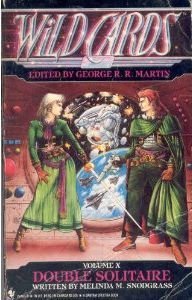
The Wild Cards series of books, edited by George R.R. Martin was set in a version of our world in which a strange virus mutated some of the population, giving super powers to a few and making others into grotesque outcasts.  In Book 9, Jokertown Shuffle, things got TG to the extreme when the very male Dr. Tachyon is switched into the body of a teen-age girl by his own sociopathic son.

The story line delved into some ugly realities faced by women–  Tachyon is raped and abused by his son– in way I had never seen up to that point, and it juxtaposed that story line brilliantly with a fairy-tale princess vision of reality, with Tachyon finding himself a damsel in distress, having dreams where he is in a Alice in Wonderland fairy world, passively hoping to be rescued by a mysterious figure known as The Outcast.

The combination of these various very feminine/female fears and fantasies being imposed on a man fascinated me, delving into those questions of behavior and the line between biology and free-will.  Tachyon, initially horrified to have something growing inside him, quickly becomes overwhelmed by his body’s maternal instincts, and helpless and desperate, he just as quickly embraces his role as a pretty young princess, dependent on a man to rescue and protect him.

At the time, I felt the book very clearly fell on the side of biology.  It seemed to say–  put a baby in a man’s belly, and he will become a mother, put a man in a woman’s body, and he will start to have female fantasies.   I feel now, re-reading the book, that I may have misjudged.  Tachyon does not just find himself in a young woman’s body– he is subjected to brutality and abuse, rape, physically and mentally tortured and imprisoned.   Could many of the behaviors that I thought were biological actually be the result of the experiences he suffered?

Clearly, these things all would have an impact, so that whatever the biology and brain chemistry he found himself swimming in as a man in a pregnant woman’s body, the abuse and imprisonment also shaped his reactions and feelings.  Abortion wasn’t an option.  He had to carry the baby, and so he chose to dedicate himself to being the best mother he could be to his unborn child.

I remain fascinated by the fairy tale elements of Tachyon’s journey into motherhood and the impact being turned into a damsel in distress had on him and might have on other types of men. It’s something I have explored and continue to explore in my own writing.  Many of my stories use fairy tale tropes and Jungian archetypes, and I continue to like to write about the interaction between biology, environment and culture when it comes to gender identity.  I think there are some men out there who would become good mothers, but my feeling is that most of them would not primarily due to fear and ego.  Maybe I’ll write about that sometime soon.

Check it Out on Amazon!

The Identity Matrix: (Spoilers)

IMatrix

I stumbled upon Jack Chalker’s The Identity Matrix while  browsing at a Dalton Books in the mall back in the 1980s.  This was before the Internet was big, before ebooks existed, and my search for media dealing with sex-change and TG issues involved spending a lot of time in libraries and bookstores just searching and searching through the books, looking for titles and covers and blurbs that hinted I might find some TG content, which at the time seemed rare.

And there it was, right in my hands, a book that seemed like it had come right out of my own imagination, tapping into and adding ideas to the thoughts and dreams I had been having;  a body-swap story, and one that featured a male character that kind of reminded me of myself– bookish, shy, bad with women,Victory Gonser finds himself trapped in a female body and forced to live her life.

The other body-swap media I’d found up to this point always shied away from sex, instead dealing with other gender issues such as clothes, objectification, behavioral challenges like putting on make-up or wearing high-heels.  But the The Identity Matrix delved into the questions of sexual identity, and especially after the mind-wipe scene which seared itself into my memory.

In this scene, Gonsor has been living as a woman for a time, but nefarious forces decide to erase his memory and make him believe he has always been a woman named Misty Ann Carpenter, a stripper and enthusiastically erotic woman.   The idea of him being given such a feminine name thrilled me, and the new life as a stripper, something that was so utterly female, and where he would be displaying his body to men as an object of pleasure–  a total reversal far more radical than say, a businessman becoming a business woman.   The scene went something like this, with the character hooked up to some sort of apparatus and a voice asking him questions:

What is your sex?

“Male.”

What is your sex?

“Female.”

What is your name?

“Victor Gonser.”

What is your name?

“Misty Ann Carpenter.”

It wasn’t working! She thought.  The mind swipe was failing.  She was Misty Ann Carpenter, and she would never forget it!

It was a powerful concept to me, frightening and alluring, that someone could be erased.  They could be turned into someone else.  Frightening because I didn’t like the idea I could be erased, and alluring because I longer to rewrite myself, to become someone different.

Later, the Victory and Misty personalities merge, and that is where I liked the character and the story best, because Victor now has the body language and behaviors of a flirty stripper, something which is noted by the other characters, and which he flaunts as he not only accepts but revels in his new identity that merges his male and female selves.

I know over the years some have criticized Chalker’s writing, the style, skill, maybe even his commitment to craft.  But I leave all of those questions to others.  To me, Chalker’s book was a rare and special document that came along at an important time in my life, and helped to both fuel my own explorations of identity as well as to realize that I was not alone, because someone else was writing the things I was feeling, and other people were reading it as well.

Check It Out On Amazon

NY Times on blurring gender lines

20GENDER-slide-YNHK-videoSixteenByNine1050-v2

Breaking Free of Boundaries

I dream a dream of fashion anarchy, where people just wear what they want depending on who they feel they are on a given day or a given time of life.

And unisex clothing is not the answer.

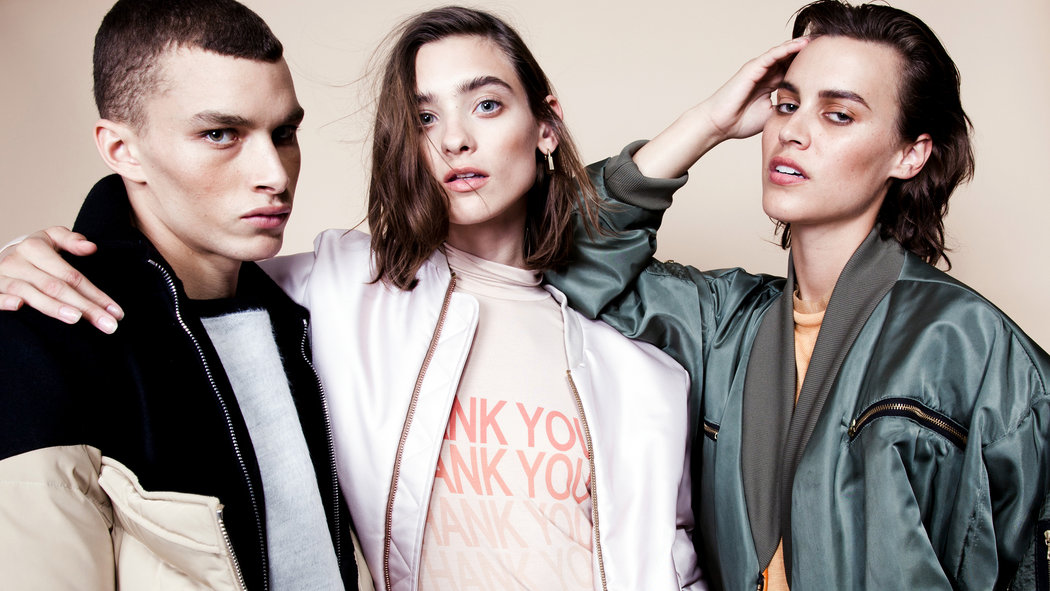
Today’s New York Times features an article on the blurring of gender lines in fashion, with more and more designers opting for unisex clothing lines in which all their items are sold without any male/female labeling or identification. The clothes are awesome, and I support and applaud anyone who likes them and wears them, but I long for a more expressive world.

And what would that more expressive world look like?  That world, to me, would include fashions that fell everywhere from the extremely feminine to the extremely butch, and in my world people could wear whatever they felt like on any given day in any given season.  If a woman wanted to dress in “dude” clothes, she could, or unisex, or if she felt like getting all dolled up and showing off all her curves, that would be fine, too on any given day for any reason.  Ditto a man.

What I see in the pictures that accompany the articles are a bunch of gorgeous, rail-thin models with androgynous features, all hints of curves or angularity hidden beneath loose, baggy clothes. The designer Kimberly Wesson, who wears her own unisex fashions, complains that her friends plead with her to wear a “sequined skirt” or to dress like “Joan from Madmen.”  Her designs are great, and she should wear the hell out of them, but why create a new set of restrictions in which unisex is an iron-bound fashion rule just as a inflexible and rigid a code as any other?  In which people are hiding their bodies?  In the name of being gender free, do we have to become gender-less?

I realize my vision for an expressive world that opens up opportunities for expression and includes more rather than less options may well be an unrealistic fantasy.  Even in my own writing I have yet to write a story where it exists, though maybe I will now that I think about it.  I think any trend that involves blurring of gender lines is a good trend.  The article asserts that more and more members of the younger generation are comfortable with gender free clothing, though, predictably, this trend is more female-centric as it has long been more acceptable for women to adopt men’s fashion that the other way around.

The changes are good, and I applaud all of the designers moving away from rigid notions of male and female clothing, but I want more.

I dream a dream of fashion anarchy, where people just wear what they want depending on who they feel they are on a given day or a given time of life.  I want total freedom all the time for everyone.

All Screwed Up (Spoilers!)

allscrewed

Falling solidly in the center of the “Freaky Friday”-style body swap movie, All Screwed Up features a switch between a nerdy African American high-school girl with ADD and a popular white male jock with ambitions of earning a college scholarship.  It’s a walk a mile in my shoes kind of gender swap that offers some interesting wrinkles.

For one thing, the girl is an outcast, a poor dresser and an unwanted female who does not have to put up with any kind of boorish male attention.   So, when the guy becomes her, he doesn’t find himself suffering from unwanted sexual attention as is often the case, but instead, he is either ignored or bullied and ridiculed, especially by his old girlfriend.  He hates his life, and cannot imagine being stuck living as her not so much because he is now female but because as her he is a nobody.  Her body also suffers from ADD, and he struggles as he experiences her inability to focus.

Meanwhile, the nerdy girl finds her new life thrilling as she goes to parties, gets to hang out with the cool kids and even is able to physically bully some of the guys.  She flatly admits that she would rather stay HIM, and seems callous to his despair at being stuck in her body.   She does get to talk to some of his friends about their bullying and tries to get them to stop, but it is clear she would rather be a dude and a protector than go back to being a nerdy girl victim.  Of course, things can’t stay easy for her, and she eventually faces struggles when she tries to play his role as a basketball star and fails, consequently becoming the object of scorn and ridicule.

The boy, facing the reality that he may be stuck as her, eventually starts dressing cute and doing things to be more attractive, and he ultimately offers to remain in her body if it will make her happy.  The two fall in love, and what I ultimately loved about this movie was this message- that it was the empathy they each gained, their understanding of the other’s lives, that let them fall in love and appreciate each other.

This can’t be called a perfect film, but the actors are game and do their best to bring these characters to life as people and not just types, and I felt for the characters as they went through their journeys.  I gotta say I dug it, and if you want to check it out you can see it on Amazon.

All Screwed Up on Amazon