Wild Cards, a princess and a pregnancy (Spoilers)

wildcards

How would a man react to being turned into a pregnant woman?

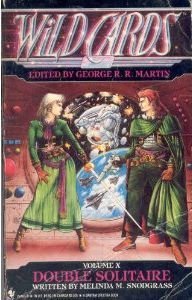
The Wild Cards series of books, edited by George R.R. Martin was set in a version of our world in which a strange virus mutated some of the population, giving super powers to a few and making others into grotesque outcasts.  In Book 9, Jokertown Shuffle, things got TG to the extreme when the very male Dr. Tachyon is switched into the body of a teen-age girl by his own sociopathic son.

The story line delved into some ugly realities faced by women–  Tachyon is raped and abused by his son– in way I had never seen up to that point, and it juxtaposed that story line brilliantly with a fairy-tale princess vision of reality, with Tachyon finding himself a damsel in distress, having dreams where he is in a Alice in Wonderland fairy world, passively hoping to be rescued by a mysterious figure known as The Outcast.

The combination of these various very feminine/female fears and fantasies being imposed on a man fascinated me, delving into those questions of behavior and the line between biology and free-will.  Tachyon, initially horrified to have something growing inside him, quickly becomes overwhelmed by his body’s maternal instincts, and helpless and desperate, he just as quickly embraces his role as a pretty young princess, dependent on a man to rescue and protect him.

At the time, I felt the book very clearly fell on the side of biology.  It seemed to say–  put a baby in a man’s belly, and he will become a mother, put a man in a woman’s body, and he will start to have female fantasies.   I feel now, re-reading the book, that I may have misjudged.  Tachyon does not just find himself in a young woman’s body– he is subjected to brutality and abuse, rape, physically and mentally tortured and imprisoned.   Could many of the behaviors that I thought were biological actually be the result of the experiences he suffered?

Clearly, these things all would have an impact, so that whatever the biology and brain chemistry he found himself swimming in as a man in a pregnant woman’s body, the abuse and imprisonment also shaped his reactions and feelings.  Abortion wasn’t an option.  He had to carry the baby, and so he chose to dedicate himself to being the best mother he could be to his unborn child.

I remain fascinated by the fairy tale elements of Tachyon’s journey into motherhood and the impact being turned into a damsel in distress had on him and might have on other types of men. It’s something I have explored and continue to explore in my own writing.  Many of my stories use fairy tale tropes and Jungian archetypes, and I continue to like to write about the interaction between biology, environment and culture when it comes to gender identity.  I think there are some men out there who would become good mothers, but my feeling is that most of them would not primarily due to fear and ego.  Maybe I’ll write about that sometime soon.

Check it Out on Amazon!

Turnabout Intruder: Thoughts and Speculations

turnabout

“She could have had as rich a life as any woman.  If only… If only….”

The last lines of the last episode of the original Star Trek television series, and the first body swap story I remember ever seeing.  I was young– pre-teens, and I loved Star Trek, which was in constant re-runs on the UHF stations that broadcast out of Detroit back in the 1970s.

Growing up without a father, I had chosen Captain James T. Kirk as a hero and role model, so it was a strange and fascinating thing to see this episode in which he found himself trapped in the body of a woman.  My hero?  my role model?  A girl?  Yet, early in the episode, the characters who put Kirk in that body still refer to him as a he, despite the female form.

Aha!  That excited and interested me.  He was still a he, even though he was a girl?

The episode raised a lot of questions that I had never really consider, particularly in the court martial scenes. “You claim to be Captain Kirk?”  Lester asks, smirking and laughing at the red-haired woman wearing some kind of weird mod pantsuit.

“No,”  Kirk answers.  “I claim that whatever makes James Kirk a unique entity is being held in this body.”    What I heard him saying, though I didn’t have the words, was, “I am not my body.  The thing that makes me who I am is not this woman’s shape.”

The essence of a person, their gender, their THEM, was independent of their form.  Being, to borrow philosophical terms later in life, was independent of essence.

The iconic nature of the role reversal that lit up my young mind.  Kirk, in the woman’s body, being carried around effortlessly by the man, like the women on the covers of my mother’s romance novels.  Kirk on his knees after being physically over-powered by his former male body.  Kirk, reaching for and grabbing Spock’s hand.  Placed in a woman’s body, Kirk was forced into a woman’s traditional role, pleading with the men in his life to rescue him.  In the end, of course, he saves himself through action, as men are supposed to do, but it is not as a man that James Kirk saved himself; it was as a woman, and that to me seemed to suggest that biology was not, as some would suggest, destiny.

Though I believe it may have been an attempt at a feminist statement, the episode has since been condemned for being sexist, retrograde.  The woman in Kirk’s body is prone to fits of hysteria, loves to file her nails and proves incapable of commanding a star ship.  At one point when she complains about the lack of opportunity for women,Kirk agrees with her that life is unfair for women, but with the kind of dismissive “Whaddya gonna do?”  attitude that is still far too prevalent.   The last lines of the episode are specific.   She could have lived a life as rich as any woman.  Not, clearly, as rich as any man, which was the real issue.

Still, I feel it holds up well both as an exploration of the cost of gender bias as well as a exploration of a body swapping gender reversal.  In the end, Lester’s ultimate defeat and punishment is to be trapped in a traditional gender role– to be dependent on a man for her care and protection.  What could be a more powerful statement against the notion of domestic bliss as the be all and end all for women than the image of a woman, broken and weeping with despair at the thought of being stuck marrying a doctor who wants her to just stop striving and be his wife?  And that was back when television shows portrayed that every woman on Earth creamed her jeans at the thought of marrying a doctor.

If you haven’t seen it, or haven’t seen it lately, check it out on Amazon or Netflix,  Sandra Smith is great as Captain Kirk:

http://www.imdb.com/title/tt0708485/